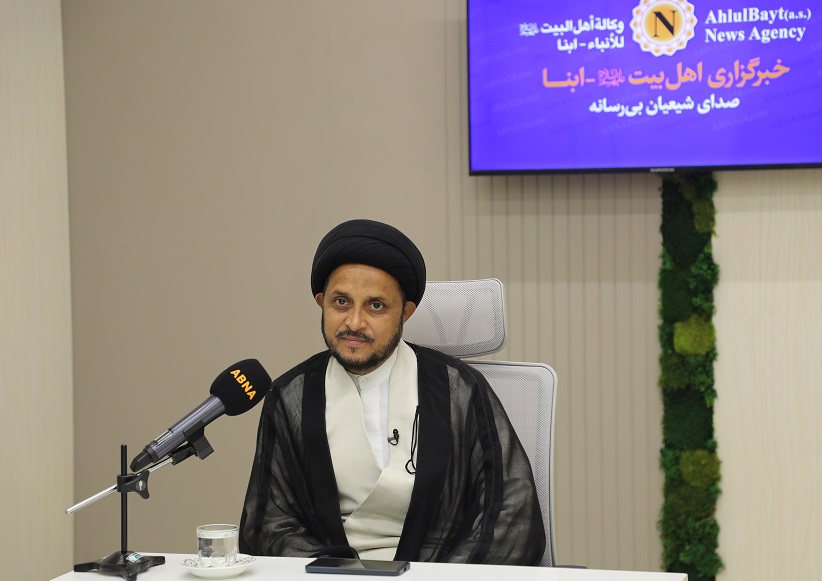
AhlulBayt News Agency (ABNA): The emergence of Shiite Islam in the Indian subcontinent coincided with the arrival of Muslims in the region during the rule of Imam Ali (a.s.). The humane conduct of Imam Ali’s (a.s.) administrators in Sindh inspired deep affection and devotion among the people of the subcontinent towards Imam Ali (a.s.) and the AhlulBayt (a.s.).
India, once a cradle of diverse religions and peaceful coexistence among their followers, has, in recent years, witnessed conflicts between Muslims and Hindus. This raises questions about the roots of these tensions and the challenges Shiites face in this period of India’s history.
In this regard, Hojat al-Islam Sayed Mohammad Reza Razavi Gharavi, head of the AhlulBayt (a.s.) Assembly of India discussed these issues in an interview with an ABNA correspondent as follows:
The AhlulBayt (a.s.) Assembly of India has been active in the country for about 30 years. Initially, its activities were limited, and it was not recognized as an official organization. However, during a 2014 visit to India by Ayatollah Akhtari, the former Secretary-General of the AhlulBayt (a.s.) World Assembly, it was emphasized that the Assembly needed to function as an official organization with representation in India.
Following this visit, elections were held in 2014, and more than 104 members of the General Assembly in India were elected. Subsequently, the Supreme Council, the Executive Board, the Secretary, the President, and the Financial Officer were appointed. Since then, the local Assembly has conducted elections every three years. Following the most recent elections, I assumed the presidency of the assembly.
The AhlulBayt (a.s.) Assembly of India Has Been Officially Registered
Over the past decade, the AhlulBayt (a.s.) Assembly of India has organized various activities, including conferences, seminars, book publications, special editions, and commemorating Islamic occasions like birth and martyrdom anniversaries.
The local Assembly in India has been officially registered. Initially, it was supposed to be named “AhlulBayt (a.s.),” and the constitution referred to it by this name. However, when seeking government approval, the term “Assembly” (The AhlulBayt (a.s.) World Assembly) was not authorized, as this title was exclusively reserved for the parliament. Therefore, during a general meeting, it was decided that the name should be changed. It is now officially registered as “The AhlulBayt Consul of India.”
Growing Interest in Shiite Islam in India
The Assembly has been actively organizing programs across India during Imam Hussain’s (a.s.) mourning days, the Fatimiyyah (s.) days, and the Ten Days of Dignity (Ten days between the birthdays of Lady Masoumeh (a.s.) and her brother Imam Reza (a.s.)). It also held two courses for converts to Shiite Islam in West Bengal. I have informed the honorable Secretary-General that there is a significant inclination towards Shiite Islam in India. Still, the Indian government, due to various reasons, does not publicize this development.
It is essential to organize classes for these new converts. For instance, when someone converts from Sunni Islam to Shiite Islam, they may not be familiar with Shiite jurisprudence, including how to pray, perform ablution, or follow other rituals such as marriage and divorce laws. The AhlulBayt (a.s.) Assembly of India has held a few days of classes to teach these necessary Shiite rulings, with two sessions conducted so far. We plan to continue these efforts in the future.
The AhlulBayt (a.s.) Assembly of India also has a women’s section actively engaged in various fields. For example, they organized programs commemorating the martyrdom of General Qassem Soleimani, Ayatollah Raisi, and several other resistance commanders. These events were held under the auspices of the AhlulBayt (a.s.) Assembly of India.
Collaboration with Philanthropists and Preachers in India
The AhlulBayt (a.s.) Assembly of India has developed programs to connect with philanthropists, and approximately 30-40% of our activities are conducted with their support.
We regularly collaborate with prominent individuals and preachers. Each year, we hold the “Ashura Preachers Conference” session, which takes place at the end of Dhu al-Hijjah. During this meeting, preachers guide us on how to conduct programs in Muharram, what speeches to deliver, and what topics to address.
Ethnic and Religious Conflicts in India Have Roots in Colonialism
Britain once ruled India, but eventually, the country gained independence from colonial rule. In that period, the British implemented strategies to ensure their dominance forever, including creating divisions among various religious groups to exacerbate tensions. Over time, these conflicts diminished. However, in the last ten years, tensions have surged again, and the motives are not merely religious but also political. For some, the aim is how to get votes and be elected. Therefore, they use religion for their political gain and incite discord among Muslims. Otherwise, the Indian people – both Hindus and Muslims – do not seek such conflicts, as they maintain commercial and social relationships.
I live in Gujarat, a state renowned for its trade and commerce across India, hosting major companies. When speaking with Hindus there, they often express that we are like brothers and cannot fight each other. In Gujarat, we maintain close connections with Hindus. However, there is a political party that aims to secure power by creating disputes between Muslims and Hindus to achieve its objectives.
A Group of Hindus Loves Imam Hussain (a.s.)
Those who seek to create discord between Hindus and Muslims make no distinction between Shiites and Sunnis; their primary focus is Islam itself. It is often said that Hindus are close to Shiites, and this is true. It is well-known in India that Shiites have never been involved in terrorism, and every terrorist arrested so far has not been Shiite.
A large group of Hindus deeply loves Imam Hussain (a.s.), and they are referred to as “Hussaini Brahmins.” They organize grand mourning ceremonies. Prominent figures among these Hindus include General Bakshi of the Indian Army and Mr. Dharmendra, an author of a book on mourning practices in India. Both are known for their deep admiration for Imam Hussain (a.s.).
The People Support Resistance; the Government Supports Israel
This issue can be analyzed from two perspectives: the government’s stance and the people’s perspective. The government supports Israel, which contradicts the views of Gandhi, who never recognized Israel. The current government not only supports Israel but has also sent numerous military personnel and weapons to Israel. Unfortunately, these two countries maintain commercial relations, with Israel establishing various centers in India and even purchasing lands for future use.
On the other hand, the Indian people support the resistance and frequently voice their solidarity with the oppressed people of Palestine. Today, Muslims around the world acknowledge that only Iran supports the oppressed, while Saudi Arabia merely carries the title of a Muslim nation. Consequently, many Muslims have distanced themselves from Saudi Arabia. Even Sunni scholars openly state that Saudi Arabia or the UAE does nothing for Muslims or the oppressed, while only Iran remains committed to their cause.
Unfortunately, certain media outlets influenced by the United States and Israel disseminate false news in India. However, Muslims and Shiites respond to such propaganda. Recently, Mr. Zamir Jafari, who resides in Iran, gave an excellent interview on television on Hezbollah in Lebanon and Palestine. His statements were accurate and resonated successfully with the audience.
The Joy of Indians Over the Operation True Promise
When this event occurred, the people of India celebrated. Both Shiite and Sunni communities were pleased that Iran had finally carried out Operation True Promise against Israel. Initially, some media outlets claimed that Israel had not suffered any significant damage. However, as the news spread on social media, even those outlets admitted that Israel had been dealt heavy blows. These reports highlighted that despite Israel’s advanced capabilities, it failed to defend itself against Iranian missiles.
The Reflection of the Leader’s Historic Friday Prayer in India
On the day the Supreme Leader came to India to lead the Friday prayer, all news channels broadcast the event live. No channel aired any other news during this time. Some networks even requested translators from different offices to provide a live translation of the Supreme Leader’s Friday sermon.
For Indian Shiites, a particularly noteworthy aspect was hearing the phrase “اشهد أنّ علیّا ولیالله” (Ashhadu anna Aliyyan Waliyyullah) repeated several times, making it the first time in history that such a declaration resonated globally.
The October 7th Operation: A Golden Point of Unity for Muslims
The October 7th Hamas attack was a divine blessing for India because, following this event, a strong sense of unity emerged among Muslims, which was a significant blessing for us. Wahhabism has made considerable efforts in India but given the large number of Sufi Indians with inclinations towards the AhlulBayt (a.s.), Wahhabism has not gained much traction in public circles, despite heavy investments from Saudi Arabia. This recent event significantly weakened Wahhabism and fostered unity among Muslims.
There was a time in India when the government sought to sow discord among Muslims to provoke infighting. However, Muslims have now realized the enemy’s intentions. Consequently, it has become much easier to work together, and unity and solidarity among Muslims have strengthened. Even figures like Salman Nadwi, who was once a staunch Wahhabi, have now become admirers of the AhlulBayt (a.s.) and present strong arguments in their favor. Given their significant followings, individuals like him are likely to have a profound impact on Sunni communities.
**************
End/ 345